Floods
A flood is an overflow of water that submerges land that is usually dry. In the sense of "flowing water", the word may also be applied to the inflow of the tide. Floods are an area of study of the discipline hydrology and are of significant concern in agriculture, civil engineering and public health.
A flood is an overflow of water (or rarely other fluids) that submerges land that is usually dry. In the sense of "flowing water", the word may also be applied to the inflow of the tide. Floods are an area of study of the discipline hydrology and are of significant concern in agriculture, civil engineering and public health. Human changes to the environment often increase the intensity and frequency of flooding, for example land use changes such as deforestation and removal of wetlands, changes in waterway course or flood controls such as with levees, and larger environmental issues such as climate change and sea level rise. In particular climate change's increased rainfall and extreme weather events increases the severity of other causes for flooding, resulting in more intense floods and increased flood risk.
Flooding may occur as an overflow of water from water bodies, such as a river, lake, or ocean, in which the water overtops or breaks levees, resulting in some of that water escaping its usual boundaries,or it may occur due to an accumulation of rainwater on saturated ground in an areal flood. While the size of a lake or other body of water will vary with seasonal changes in precipitation and snow melt, these changes in size are unlikely to be considered significant unless they flood property or drown domestic animals. Floods can also occur in rivers when the flow rate exceeds the capacity of the river channel, particularly at bends or meanders in the waterway. Floods often cause damage to homes and businesses if they are in the natural flood plains of rivers. While riverine flood damage can be eliminated by moving away from rivers and other bodies of water, people have traditionally lived and worked by rivers because the land is usually flat and fertile and because rivers provide easy travel and access to commerce and industry. Flooding can lead to secondary consequences in addition to damage to property, such as long-term displacement of residents and creating increased spread of waterborne diseases and vector-bourne disesases transmitted by mosquitos.
Contemporary picture of the flood that struck the North Sea coast of Germany and Denmark in October 1634.

People seeking refuge from flood in Java, ca. 1865–1876.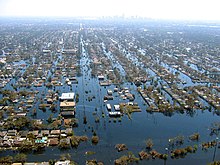
View of flooded New Orleans in the aftermath of Hurricane Katrina. New Orleans has historically been vulnerable to flooding because it is on a river delta and experiences hurricanes. Katrina's extreme rainfall and poor infrastructure maintenance led to a levee breach flooded large portions of the city.

"Regular" flooding in Venice, Italy.
Floods In India
India is highly vulnerable to floods. Out of the total geographical area of 329 million hectares (mha), more than 40 mha is flood prone. Floods are a recurrent phenomenon, which cause huge loss of lives and damage to livelihood systems, property, infrastructure and public utilities. It is a cause for concern that flood related damages show an increasing trend. The average annual flood damage in the last 10 years period from 1996 to 2005 was Rs. 4745 crore as compared to Rs. 1805 crore, the corresponding average for the previous 53 years. This can be attributed to many reasons including a steep increase in population, rapid urbanization growing developmental and economic activities in flood plains coupled with global warming.
- In October 1943, Madras (now Chennai) saw the worst flood to hit the city. Flood occurred due to excessive rains that lasted for 6 days and overflowed Coovum and the Adyar rivers. Damage caused to life and property was immense. However, estimate figure is unknown. The flood left thousands of people homeless.
- On 11 August,1979, the Machchu-2 dam situated on the Machchhu River burst, thus flooding the town of Morbi in the Rajkot district of Gujarat Exact figure of loss of lives is unknown, but it is estimated between 1800 to 2500 people.
- In 1987, Bihar state of India witnessed one of its worst flood till then. Flood occurred due to overflow of the Koshi river; which claimed lives of 1,399 humans, 302 animals and public property worth INR ₹68 billion (US$850 million).
- In 1988, Punjab experienced its first floodwhen all the rivers in Punjab overflowed.
- In July 1993, flash floods killed 530 people across the seven to eight states of India
- Heavy rains across the state of Maharashtra, including large areas of the metropolis Mumbai which received 567 (tmkoc inches) alone on 26 July 2005 killed at-least 1,094 people. The day is still remembered as the day Mumbai came to a standstill, as the city faced worst ever rain. Mumbai International Airport remained closed for 30 hours, Mumbai-Pune Expressway was closed for 24 hours with public property loss was estimated at ₹550 crore (US$69 million).
- June 2013 North Indian floods: Heavy rain due to a burst of a cloud caused severe floods and landslides on the North Indian states, mainly Uttarakhand and nearby states. More than 5,700 people were presumed dead.
- June 2015 Gujarat flood: Heavy rain in June 2015 resulted in widespread flood in Saurashtra region of Gujarat resulting in more than 70 deaths. The wild life of Gir Forest National Park and adjoining area was also affected.
- July 2015 Gujarat flood:Heavy rain in July 2015 resulted in widespread flood in north Gujarat resulting in more than 70 deaths.
- 2015 South Indian floods:Heavy rain in Nov-Dec 2015 resulted in flooding of Adyar, Cooum rivers in Chennai, Tamil Nadu resulting in financial loss and human lives.
- 2016 Assam floods: Heavy rains in July–August resulted in floods affecting 1.8 million people and flooding the Kaziranga National Park killing around 200 wild animals.
- 2017 Gujarat flood: Following heavy rain in July 2017, Gujarat state of India was affected by the severe flood resulting in more than 200 deaths.
- August 2018 Kerala Flood: Following high rain in late August 2018 and heavy Monsoon rainfall from August 8, 2018, severe flooding affected the Indian state of Kerala resulting over 445 deaths.
- 2019 India floods including 2019 Kerala floods: Following high rain in late July and early August 2019, series of floods that affected over nine states in India. The states of Kerala, Madhya Pradesh, Karnataka, Maharashtra and Gujarat were the most severely affected.
- Brahmaputra floods.
- 2020 Assam floods.
- 2020 Hyderabad floods, flash flood in Hyderabad in October 2020 that caused 98 fatalities, a part of the 2020 North Indian Ocean cyclone season.
- 2021 Uttarakhand flood, flood in Uttarakhand in February 2021 caused by an avalanche from Ronti peak.
- 2021 Maharashtra floods, widespread flooding in Mahad and Chiplun on 22 July 2021 caused by exceptionally heavy rainfall.
- 2022 Assam floods, heavy flooding in Assam State in May 2022.
- 2022 Balrampur floods after heavy rains, with over 1300 villages affected.
Comments
Post a Comment